The 2027 Ford Expedition delivers 108.5 cu ft of maximum cargo space, with the MAX stretching that to 123.1 cu ft. That is a meaningful 14.6 cu ft gain over the standard wheelbase, which changes what you can haul on any given day. This page breaks down every interior measurement across both wheelbases so you can shop with confidence at Canton Ford.
The 2027 Expedition comes in two body lengths. The standard wheelbase sits at 122.5 inches. The MAX stretches the wheelbase to 131.5 inches, adding 12 inches of overall body length for a total exterior length of 221.7 inches versus 209.9 inches on the standard model.
That extra length pays off entirely in the cargo area behind the third row. Passenger space, headroom, and legroom across all three rows remain consistent between the two wheelbases, which means every adult in the vehicle rides equally well regardless of which body you choose. The decision between Expedition and Expedition MAX comes down to one question: how much gear do you need to carry alongside your passengers?
Families in Canton and across the surrounding area who routinely haul sports equipment, camping gear, or oversized cargo will find the MAX’s numbers particularly relevant.
Ford measures cargo volume at three distinct positions, each representing a real-world loading scenario. Here is exactly what the numbers mean for both wheelbases.
All seats in use: This is the everyday-driving number. With all eight passengers seated, the standard Expedition holds 22.9 cu ft. The Expedition MAX holds 37.4 cu ft. That difference of 14.5 cu ft is enough to fit a full set of weekend luggage for a family of four or a loaded cooler and gear bags for a day trip.
Third row folded: Fold the third row flat and the standard Expedition opens up to 69.9 cu ft. The MAX grows to 84.5 cu ft. At this configuration both vehicles can carry sheets of plywood, a flat-pack furniture order, or bicycles without disassembly.
Second and third rows folded: Maximum cargo mode gives the standard Expedition 108.5 cu ft and the Expedition MAX 123.1 cu ft. At 123.1 cu ft, the MAX can swallow a kayak, a folded crib, or everything a family of five is moving into a dorm room.
The MAX also carries more fuel to match its longer range of duty: 27.8 gallons versus the standard model’s 23.6 gallons.
Because the extra length on the MAX is added behind the third row, the passenger compartment measurements are virtually identical across both wheelbases. Here is a row-by-row look at the verified interior dimensions.
| Seating Row | Headroom | Legroom | Hip Room | Shoulder Room |
|---|---|---|---|---|
| First Row | 41.8 in | 43.9 in maximum | 62.3 in | 64.9 in |
| Second Row | 40.0 in; 37.9 in on Tremor | 41.1 in standard; 42.2 in with seat fully rearward | 62.3 in | 64.8 in |
| Third Row | 37.4 in | 36.5 in standard; 43.5 in with second row fully forward | 51.4 in | 64.2 in standard; 64.3 in maximum |
Total passenger volume is 175.0 cu ft on both the standard and MAX wheelbases (the Tremor trim registers 171.8 cu ft due to its taller suspension geometry).
Seating capacity is 8 on all trims except the King Ranch, which seats 7 due to its standard dual captain’s chairs in the second row.
The standard Expedition’s exterior width is 80.0 inches excluding mirrors, or 84.6 inches with mirrors folded. That figure is identical on the MAX, which means neither vehicle requires more lane width or garage clearance side to side.
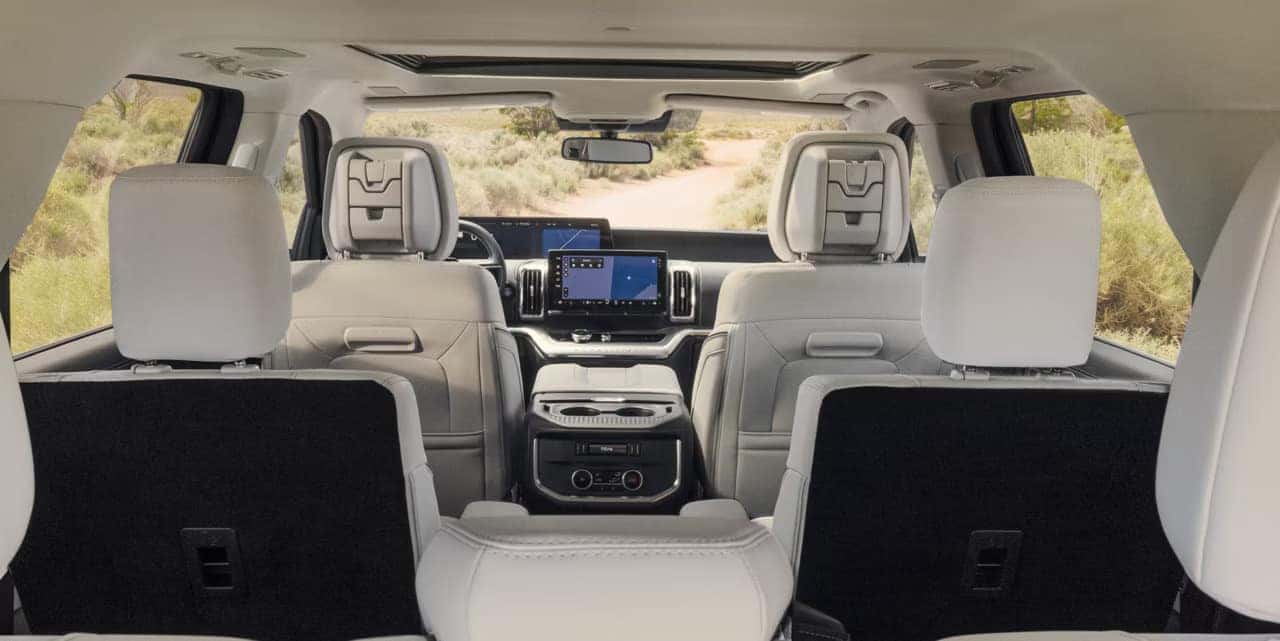
Those second-row leg and hip figures matter most on a long drive. With 42.2 inches of legroom when the second-row seat tracks fully rearward, adult rear passengers have more legroom than many business-class airline seats.
Third-row access is handled by a power-folding 40/20/40 second-row bench with a tip-and-slide function on Active, Tremor, and Platinum trims, so getting to the back seat does not require a gymnastics routine.
The 37.4-inch third-row headroom number is where full-size SUVs typically compromise. The Expedition holds that measurement on both wheelbases, which means a 5-foot-10-inch teenager sits upright rather than hunching.
For cargo, the split-level Ford Split Gate is the feature that turns those cubic-foot numbers into practical usefulness. The powered upper liftgate swings up while the powered lower tailgate drops down, letting you load at a comfortable height without lifting over a high floor. With a 500-lb capacity, the lower gate doubles as a loading platform or tailgate seat at a Friday night game in Canton.
The available Flex Powered Console adds another practical layer. It slides toward the rear of the center console, opening an aisle between the front seats and putting cupholders within easy reach of second-row passengers. On a long Texas highway run, that small change removes most of the front-seat reach-back gymnastics parents know too well.
For families comparing the standard to the MAX: if your third-row cargo number is the deciding factor, the MAX adds enough space to carry a kayak flat without folding any seats. That alone justifies the longer wheelbase for outdoor-oriented owners.
Ford does not publish competitor specs, and this page relies only on verified Expedition data, but context matters. The standard Expedition’s 22.9 cu ft behind the third row is a competitive number in the full-size three-row class. The MAX’s 37.4 cu ft behind the third row puts it in a category that no standard-wheelbase SUV from any brand reaches without moving into a cargo van format.
Second-row shoulder room at 64.8 inches is genuinely class-relevant. Most three-row SUVs in this segment tighten noticeably in the second row hip and shoulder measurements, particularly when a center console is present. The Expedition’s 62.3-inch second-row hip room holds up against the widest offerings in the segment.
The 43.5-inch third-row legroom figure (with the second row tracked forward) is the number that separates the Expedition from most competitors in real-world family use. Many rivals list third-row legroom as adequate on paper but require the second row to be pushed uncomfortably far forward to achieve it. The Expedition’s tip-and-slide second row allows a balanced compromise between rows two and three.
BlueCruise hands-free highway driving, standard on King Ranch and available on Platinum, adds a dimension that competing SUVs in this class have not universally matched at this trim level. On a long Texas highway stretch between Canton and Dallas, that matters for family road-trip fatigue.
Both wheelbases of the 2027 Expedition are available through Canton Ford. Whether the standard 108.5 cu ft maximum cargo hold fits your family’s needs or you need the MAX’s full 123.1 cu ft to haul everything your crew brings, the right configuration is in our inventory. Come sit in all three rows, measure the cargo floor with your own tape, and decide which wheelbase belongs in your driveway.
The standard 2027 Expedition holds 22.9 cu ft behind the third row with all seats upright. The Expedition MAX holds 37.4 cu ft in the same configuration, a gain of 14.5 cu ft over the standard wheelbase.
Maximum cargo space with the second and third rows folded flat is 108.5 cu ft on the standard Expedition and 123.1 cu ft on the Expedition MAX.
Third-row legroom is 36.5 inches with the second row in its normal position. With the second row tracked fully forward, third-row legroom increases to 43.5 inches. This measurement is the same on both the standard and MAX wheelbases.
The standard Expedition has a 122.5-inch wheelbase and an overall length of 209.9 inches. The Expedition MAX has a 131.5-inch wheelbase and an overall length of 221.7 inches. The 12-inch wheelbase difference adds cargo depth behind the third row.
No. Passenger-compartment dimensions, including headroom, legroom, hip room, and shoulder room across all three rows, are effectively identical between the standard and MAX wheelbases. The additional length on the MAX translates entirely to cargo volume behind the third row.
First-row shoulder room is 64.9 inches, second-row shoulder room is 64.8 inches, and third-row shoulder room is 64.2 inches on the standard Expedition (64.3 inches on the MAX). Exterior width excluding mirrors is 80.0 inches on both wheelbases.
The 2027 Expedition seats up to 8 passengers on all trims except the King Ranch, which seats 7 due to its standard second-row dual captain’s chairs.
The Tremor trim has 37.9 inches of second-row headroom, slightly less than the standard 40.0 inches on other trims. The Tremor’s taller suspension geometry accounts for that difference.